


Agentic terminal and cloud orchestration platform where developers and AI agents collaborate on shell work.
What is Warp?
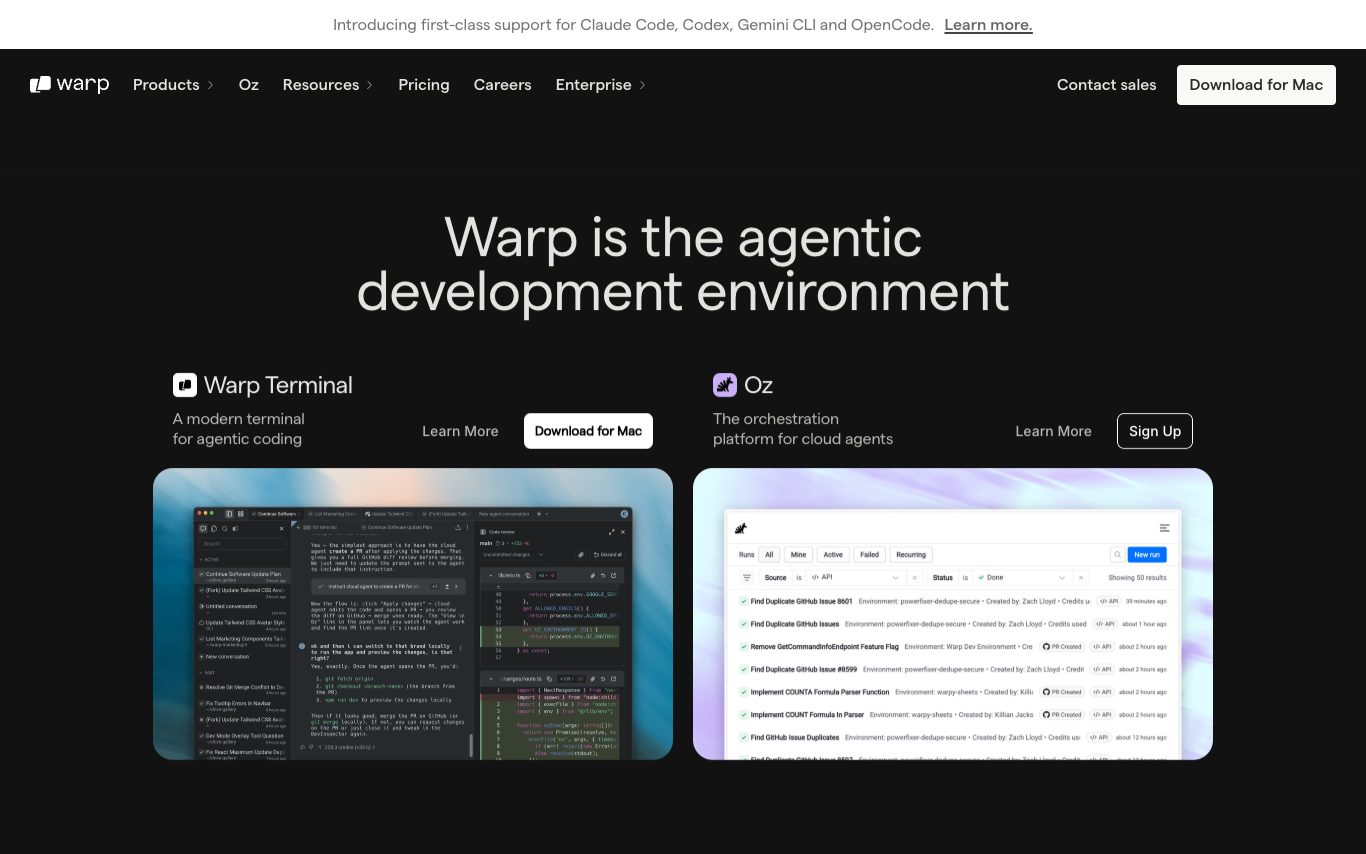
Warp is a modern terminal reimagined as an agentic development environment. Used by 700K+ developers, it replaces the traditional shell with rich input blocks, natural-language command generation, and AI agents that can plan and execute multi-step workflows. Warp ships native clients for macOS, Linux, and Windows, plus a cloud platform (Oz) for orchestrating agent runs across teams.
What can Warp do?
- 01
Modern AI-powered Terminal
A Rust-built terminal designed for agentic coding and modern development workflows
- 02
Oz Cloud Agent Orchestration
Orchestration platform for managing cloud agents across development tasks
- 03
Collaborative Coding Environment
700K+ developers use Warp for team collaboration in terminal-based workflows
Use Cases
- developers — Individual developers use Warp terminal to speed up command-line workflows with AI assistance, reducing time spent on routine shell tasks.
- engineering teams — Engineering teams at enterprises use Warp for collaborative agentic development, coordinating cloud agents across complex codebase tasks.
Quick facts about Warp
- Pricing
- Free$0/moPro$15/moTurbo$40/moEnterpriseContact salesas of Apr 18, 2026 — may be outdatedView official pricing
- Domain Rating
- Platforms
- macOS·Windows·Linux·Web
Warp Traffic Analysis
Alternatives to Warp
Looking for a Warp alternative? Compare these curated AI tools that offer similar features and use cases.
Codex
Codex is OpenAI cloud software engineering agent. It ships as an open-source terminal CLI, a cloud agent inside ChatGPT Plus/Pro/Business/Enterprise, and a GitHub reviewer that writes code, runs tests, and opens pull requests.

Claude Code
Claude Code is Anthropic's agentic coding assistant that operates in the terminal, IDE extensions, and GitHub, using Claude models to plan, edit, and execute multi-file changes across a codebase.

GitHub Copilot
GitHub Copilot is an AI pair programmer developed by GitHub and OpenAI. It provides inline code completion, Copilot Chat, pull request review, and agentic workspace features across VS Code, JetBrains, Visual Studio, Neovim, and GitHub.com.