


Upload an image and turn it into a detailed AI image prompt in seconds.
Prompt Engineering · 2 tools
Best Prompt Engineering Tools (2026)
Compare prompt engineering tools for writing, testing, and refining prompts — prompt builders, template libraries, playgrounds, chaining, and output evaluation across LLMs.
All Prompt Engineering tools
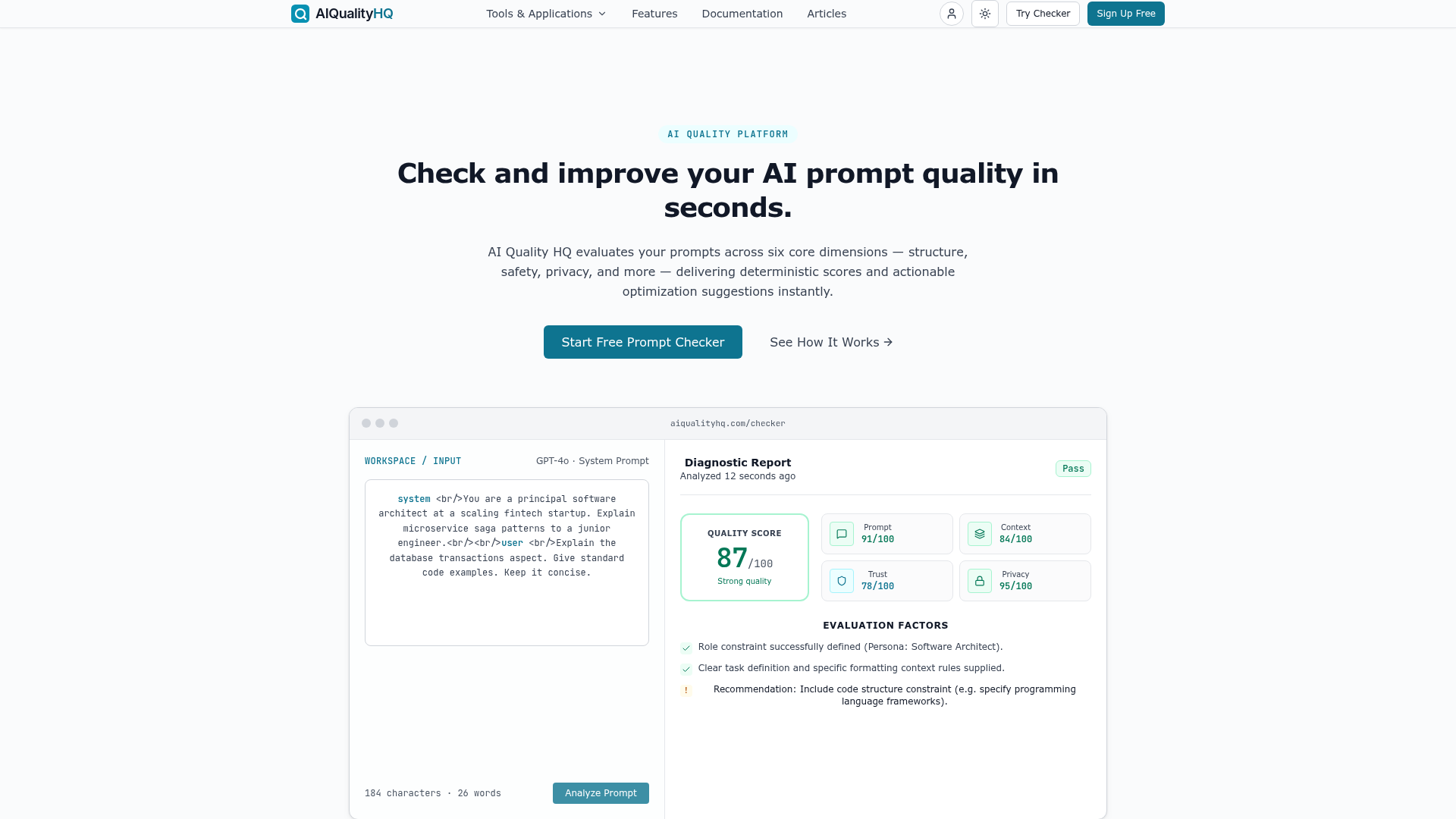

AI Quality HQ is a free, browser-based platform designed to evaluate and improve the quality of AI prompts. It instantly analyzes prompts across six core dimensions—structure, safety, privacy, and more—delivering deterministic scores and actionable optimization suggestions. The platform operates using a local, static syntax checking and rule-based engine, ensuring privacy by processing all data entirely in your browser. It's built for AI engineers, prompt engineers, and development teams who need to ensure consistent, secure, and high-quality AI outputs without relying on external API calls or risking data exposure. Users can paste any AI prompt template into the checker, run an instant analysis, and review detailed diagnostics with fix suggestions. This allows teams to catch prompt injection vulnerabilities, PII exposure, and structural issues before they impact production, integrating seamlessly into pre-deployment validation or CI/CD pipelines.
What is prompt engineering?
Prompt engineering is the practice of writing and refining the instructions you give a large language model (LLM) to get accurate, consistent output. Tools in this category help you draft, test, compare, and version prompts instead of editing them by hand. They range from prompt playgrounds and template libraries to chaining and evaluation platforms used to ship prompts into production.
What prompt engineering tools do
- Prompt editors with variables, templates, and reusable snippets
- Side-by-side testing across models and prompt versions
- Prompt libraries and marketplaces to browse and reuse
- Chaining steps into multi-prompt workflows or agents
- Version history, diffs, and rollback for prompts
- Output evaluation, scoring, and regression checks
Who uses prompt engineering tools
01
Builders shipping LLM features
Developers who test, version, and monitor the prompts powering production app features.
02
Writers crafting better prompts
Everyday users refining prompts for ChatGPT, Claude, or image models to get sharper results.
03
Teams standardizing prompts
Groups sharing approved prompt templates and libraries so outputs stay consistent.
04
Prompt sellers and browsers
People buying, selling, or discovering ready-made prompts in marketplaces and directories.
How prompt engineering tools work
You write a prompt in an editor, often with variables you fill in at run time, then send it to one or more LLMs to compare responses. Testing tools run the same prompt against many inputs and score the outputs, so you can catch regressions before shipping. Versioning and chaining features save each iteration and link prompts into multi-step flows that call the model in sequence.