

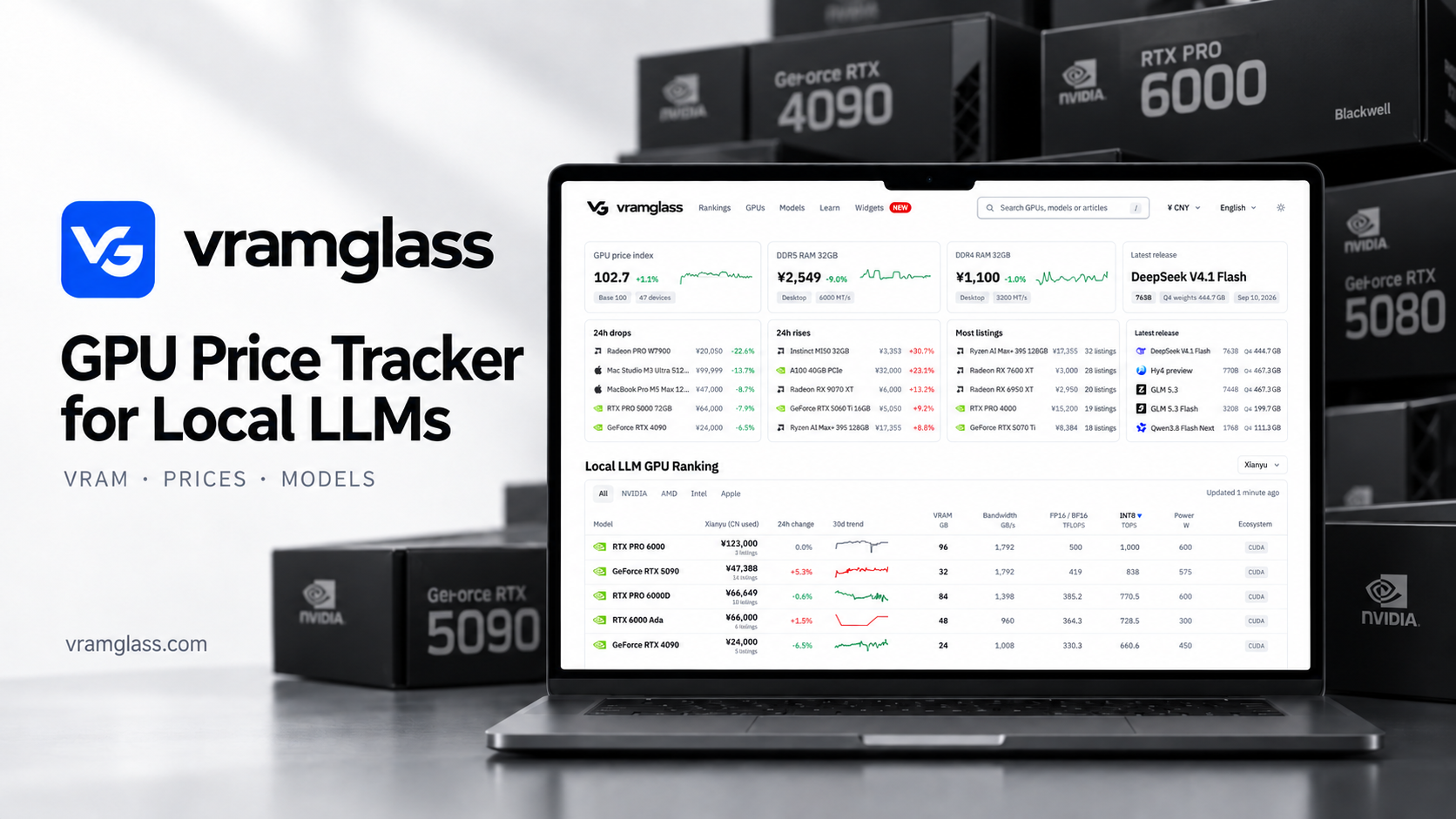

VRAMGlass is a free web tool for people choosing hardware to run large language models locally. Compare GPUs by VRAM capacity, memory bandwidth, power and software ecosystem, explore open-weight model families and their quantized weight sizes, and use documented memory and fit estimates to plan the hardware you actually need.
Large Language Models (LLMs) · 3 tools
Best Large Language Models (LLMs) Tools (2026)
Compare large language models — GPT, Claude, Gemini, Llama, and open-weight models — across context window, coding skill, API access, price, and self-hosting.
All Large Language Models (LLMs) tools


What is a large language model (LLM)?
A large language model (LLM) is a neural network trained on massive amounts of text to predict the next token, giving it broad command of language, code, and reasoning. You reach it through a chat app, an API, or a self-hosted copy, and it can follow instructions, answer questions, write and debug code, and process long documents. Examples span proprietary models like GPT, Claude, and Gemini and open-weight families like Llama, Mistral, and Qwen.
What LLMs can do
- Instruction following across writing, analysis, and reasoning tasks
- Code generation, explanation, and debugging in many languages
- Long context windows for whole documents or codebases
- API access with streaming, function calling, and JSON output
- Multimodal input: images, audio, and sometimes video
- Fine-tuning and open weights for private self-hosting
Who uses large language models
01
Developers building on an API
Call a hosted model to add chat, extraction, or agents inside an app.
02
Teams comparing frontier models
Weigh GPT, Claude, and Gemini on reasoning, coding, price, and speed.
03
Self-hosting with open weights
Run Llama, Mistral, or Qwen locally for privacy, cost, or offline control.
04
Researchers and builders fine-tuning
Adapt a base model to a domain, tone, or task with custom data.
How large language models work
An LLM is trained on huge text corpora to predict the next token, then tuned with human feedback so it follows instructions and stays helpful. At inference it reads your prompt plus any earlier turns and generates a reply one token at a time within a fixed context window. Retrieval, tool calls, and fine-tuning extend it with fresh data, external actions, or domain-specific behavior.