


Fae
AI for the cultured
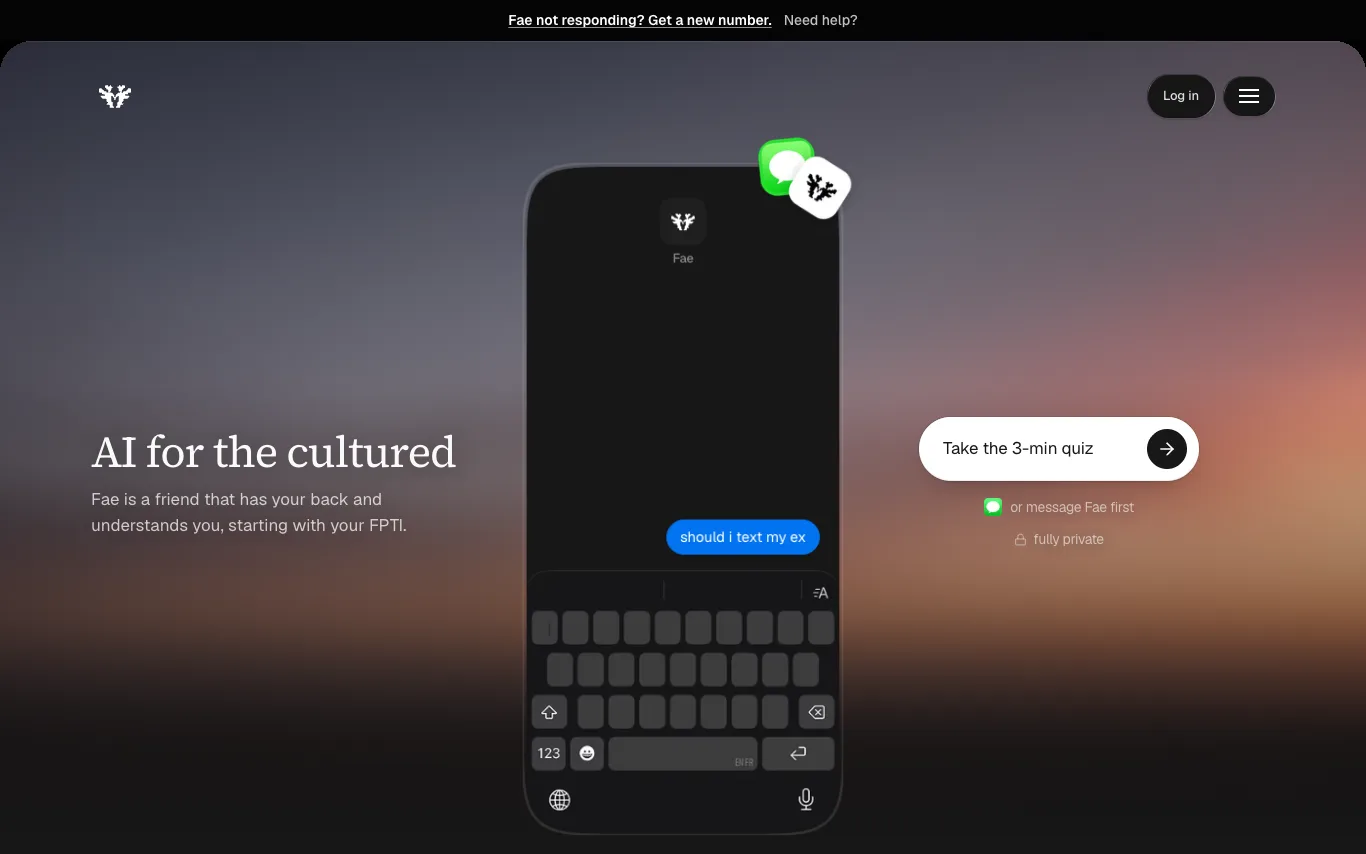
What is Fae?
Fae is an AI companion that learns from your FPTI (Fae Personality Type Indicator) and adapts to you over time. It can be messaged via iMessage and SMS, offering a personalized chat experience. Fae is described as a friend that understands you, with a focus on privacy.
What can Fae do?
- 01
FPTI-based personalization
Starts with your FPTI and never stops learning.
- 02
iMessage and SMS support
Text Fae on iMessage and SMS to start chatting.
- 03
Fully private
Emphasizes privacy in its messaging.
- 04
3-minute quiz
Take the 3-min quiz to determine your FPTI.
- 05
Archetype system
Offers various archetypes like The Natural, The Sweetheart, etc.
Use Cases
- iMessage & SMS users — Text Fae directly on iMessage or SMS to chat about anything without installing a separate app.
- People who want a personalized AI — Start from an FPTI personality profile so the AI adapts to who you are across 15 behavioural dimensions.
- Users tracking ongoing conversations — Rely on Fae remembering past chats and texting first to follow up where you left off.
- People connecting their digital life — Link Gmail, Spotify, and Instagram so Fae learns from the apps you already use, kept private and encrypted.
Quick facts about Fae
- Domain Rating
- Platforms
- Web
- Languages
- English
Fae Traffic Analysis
Alternatives to Fae
Looking for a Fae alternative? Compare these curated AI tools that offer similar features and use cases.

Microsoft Copilot
Microsoft Copilot is Microsoft's AI assistant, powered by OpenAI GPT models. It combines chat, image generation, voice mode, and web search, with deep integration across Bing, Edge, Windows, and Microsoft 365.

Doubao
Doubao is ByteDance's consumer AI assistant, powered by the Doubao model family. It offers chat, voice conversation, image generation, AI character roleplay, and integrations with ByteDance apps like Feishu and TikTok.

Qwen
Qwen is Alibaba Cloud's open and commercial LLM family and its chat interface. It covers general chat, long context, coding, math, and multimodal inputs, with both open-weight and API access.