

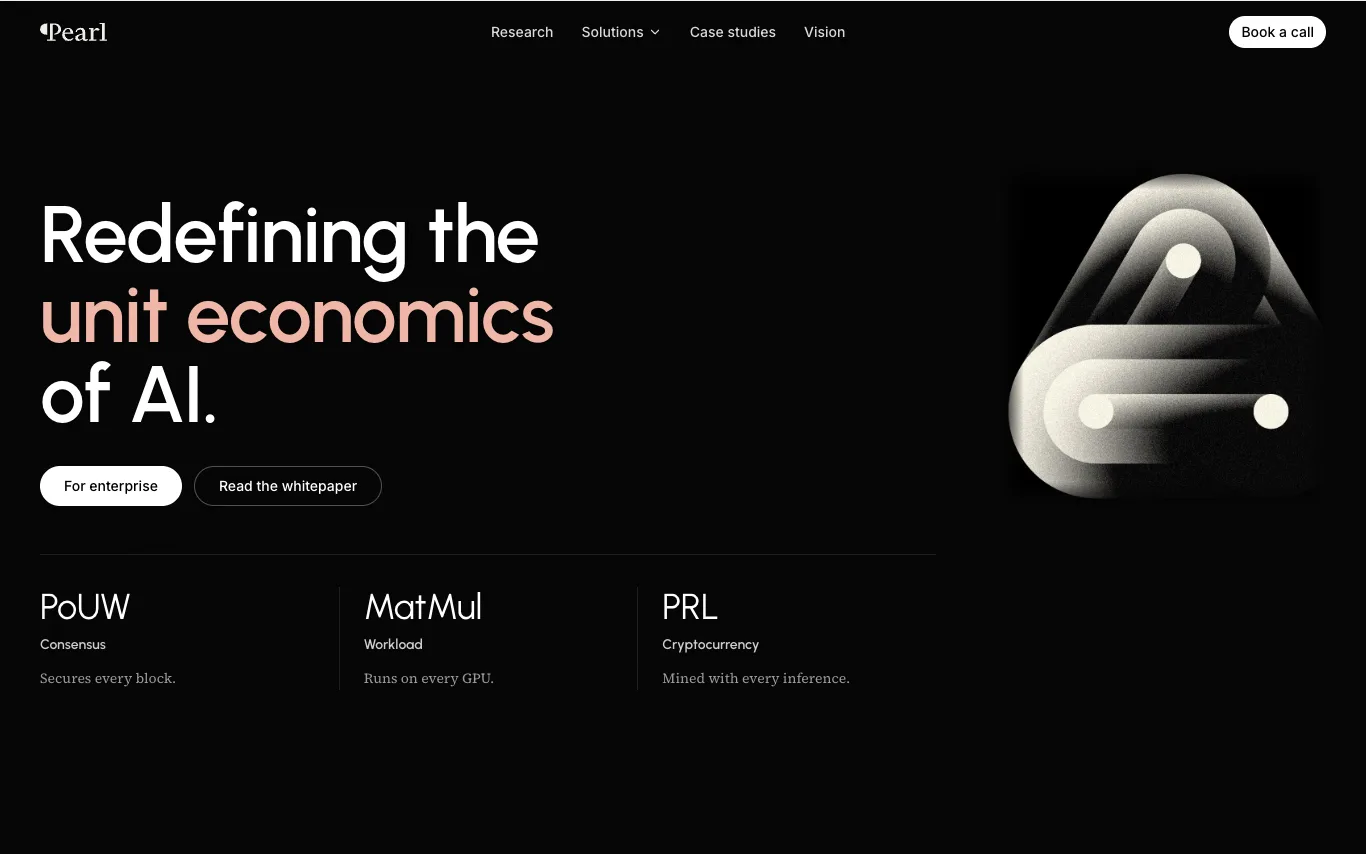

Pearl is a mathematical breakthrough that redefines the unit economics of AI: the same matrix multiplication that powers AI secures a monetary network at the same moment. It introduces Proof of Useful Work (PoUW) consensus, where every GPU cycle does double duty, securing a blockchain while performing AI inference. This creates a currency backed by the most valuable computation in the world.
Blockchain · 1 tools
Best Blockchain Tools (2026)
Explore AI tools for blockchain and crypto — smart contract writing and auditing, on-chain analytics, trading bots, AI crypto agents, and Web3 development copilots.
All Blockchain tools
What is an AI blockchain tool?
An AI blockchain tool applies machine learning and large language models to on-chain data, smart contract code, and crypto markets. It can generate and audit Solidity contracts, flag risky wallets, summarize transactions in plain English, or run autonomous trading and research agents. These range from developer copilots inside an IDE to on-chain analytics dashboards and AI-driven trading bots.
What AI blockchain tools do
- Generate and refactor smart contract code
- Audit contracts for vulnerabilities and exploits
- Explain on-chain transactions in plain language
- Track wallets, tokens, and whale movements
- Automate trading signals and portfolio rebalancing
- Detect scams, rug pulls, and phishing addresses
Who uses AI blockchain tools
01
Smart contract developers
Write, refactor, and test Solidity or Rust contracts with an AI copilot that catches bugs early.
02
Security auditors
Scan contracts and protocols for reentrancy, overflow, and access-control flaws before deployment.
03
Crypto traders and analysts
Turn on-chain flows and market data into signals, alerts, and automated trading strategies.
04
Web3 researchers and investigators
Trace fund movements, label wallets, and untangle complex transactions for due diligence or compliance.
How AI blockchain tools work
Most tools connect to public blockchain nodes, indexers, and market APIs to pull live on-chain data. A model then interprets it — an LLM reads and reasons over Solidity code or transaction traces, while trained classifiers score wallets, tokens, or contracts for risk. Trading and agent tools add execution, calling wallets or exchanges to act on what the model finds.