


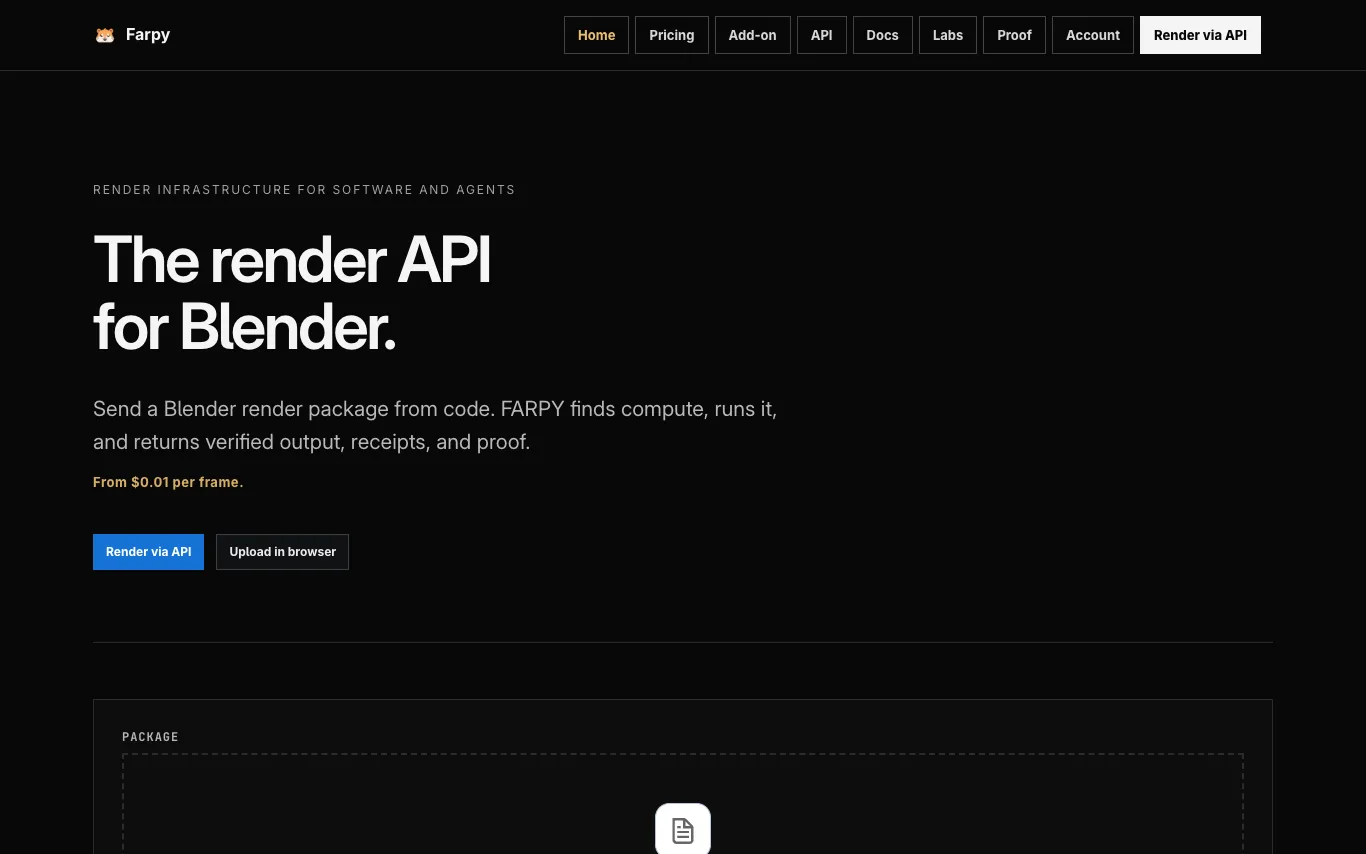

FARPY runs compute workloads and returns verified artifacts, benchmark records, execution receipts, and inspectable results. It is a render infrastructure for software and agents, offering a public API to upload, submit, track, download, and verify Blender renders. Pricing starts from $0.01 per frame, and users pay only for what renders. Uploaded .blend files are not sold, not used for AI training, and are deleted after download.
Best AI 3D Model Generator Tools (2026)
Compare AI 3D model generators that turn text prompts, photos, or sketches into game-ready meshes, textures, and printable models — for games, AR/VR, and 3D printing.
Related categories
What is an AI 3D model generator?
An AI 3D model generator is a tool that turns a text prompt, a photo, or a rough sketch into a three-dimensional model using generative AI. It outputs textured meshes in formats like OBJ, GLB, FBX, USDZ, or STL for use in game engines, AR/VR, and 3D printing. It compresses work that once took hours of manual modeling into a few minutes.
Key features of AI 3D model generators
- Text-to-3D: describe an object, get a mesh
- Image-to-3D: reconstruct a model from one photo
- Automatic texturing with PBR materials
- Export to OBJ, GLB, FBX, USDZ, and STL
- Retopology for game-ready low-poly meshes
- Auto-rigging for animation-ready characters
Who uses AI 3D model generators?
01
Game developers
Prototype props, characters, and environment assets in minutes instead of modeling each by hand.
02
3D printing hobbyists
Generate printable STL models from a single prompt without learning CAD software.
03
AR/VR and metaverse builders
Populate three-dimensional scenes with lightweight GLB assets for real-time engines.
04
Product and industrial designers
Visualize concepts and iterate on shapes quickly before committing to detailed CAD.
How AI 3D model generation works
Most tools run on models trained on large 3D datasets using diffusion or multi-view reconstruction techniques. Given text or an image, the system generates several viewpoints and reconstructs the geometry, or directly predicts a mesh or point cloud. It then wraps the surface with generated textures and materials.